
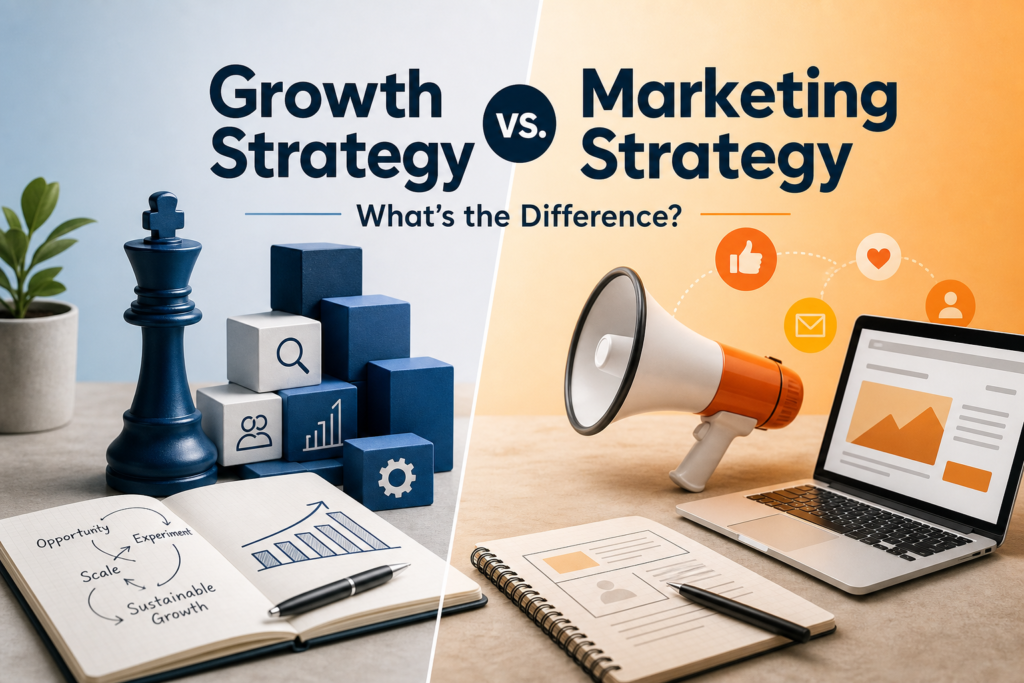
Business leaders often use growth strategy and marketing strategy as if they mean the same thing. They are closely connected, but they are not interchangeable. Confusing the two can lead to unfocused priorities, unrealistic expectations for marketing teams, and investment in campaigns that do not address the real constraints on growth.
A marketing strategy explains how a business will attract, engage, convert, and retain a defined audience. A growth strategy is broader. It explains how the business will increase its value and scale, including the markets, products, customers, channels, capabilities, and economics that support expansion.
Understanding the difference helps decision-makers allocate resources more intelligently. It also creates better collaboration between leadership, marketing, sales, product, customer success, finance, and operations. This article outlines what each strategy does, where they overlap, how they differ, and how to build an effective relationship between them.
What Is a Growth Strategy?
A growth strategy is a company-wide plan for increasing revenue, customers, market presence, profitability, or another clearly defined business outcome over time. It addresses the fundamental question: Where will future growth come from, and what must the organization do to achieve it?
Growth can come from many sources. A business might sell more to existing customers, enter a new market, introduce a new product, expand through partnerships, improve retention, increase prices, or develop a more efficient route to market. A sound growth strategy evaluates these options rather than assuming that more promotion is always the answer.
Core components of a growth strategy
- Growth objectives: The specific outcomes the business is pursuing, such as revenue expansion, customer growth, retention, market entry, or improved profitability.
- Target opportunities: The customer segments, geographies, industries, products, or use cases with the greatest potential.
- Value proposition: The reason customers should choose the company, especially in comparison with available alternatives.
- Business model: How the organization creates, delivers, and captures value.
- Growth levers: The activities most likely to produce progress, such as acquisition, activation, retention, expansion, pricing, partnerships, or product development.
- Required capabilities: The people, systems, technology, processes, and funding needed to execute the plan.
- Measurement: The financial and operational indicators that reveal whether growth is durable and economically sound.
Because it considers the whole business, a growth strategy may require changes beyond marketing. For example, a company may discover that demand is healthy but customer retention is weak. The priority may then be product improvement, onboarding, service delivery, or customer success rather than additional acquisition spending.
What Is a Marketing Strategy?
A marketing strategy is the plan for reaching a specific audience, communicating value, creating demand, and supporting the customer journey. It translates business priorities into market-facing decisions.
Marketing strategy typically covers the audiences a company wants to serve, the positioning it will use, the messages it will communicate, the channels it will prioritize, and the way it will measure marketing performance. It can include brand building, content, search, public relations, events, advertising, email, social media, partner marketing, and other activities.
Core components of a marketing strategy
- Audience definition: The customers or buying groups the business is best positioned to serve.
- Positioning: The place the company aims to occupy in the customer’s mind relative to alternatives.
- Messaging: The ideas and proof points used to explain the customer problem, solution, and business value.
- Channel selection: The places and methods used to reach, educate, influence, and convert potential customers.
- Customer journey: The experience from initial awareness through evaluation, purchase, onboarding, retention, and advocacy.
- Campaign and content plan: The programs used to activate the strategy over a defined period.
- Marketing measurement: The metrics used to assess reach, engagement, demand, conversion, efficiency, and contribution to business results.
Marketing strategy is therefore more than a promotional calendar. It should provide a coherent rationale for who the business is targeting, why those people should care, and how marketing will support commercial objectives.
Growth Strategy vs. Marketing Strategy: The Main Difference
\n

\n
The simplest distinction is scope. Growth strategy is the broader business plan; marketing strategy is one of the major plans used to execute it.
Growth strategy asks questions such as:
- Which markets and customer segments should we prioritize?
- What is the most attractive path to sustainable expansion?
- Should we improve the current offer, launch something new, or enter a new market?
- Are retention, pricing, distribution, or operational capacity limiting growth?
- What investments and capabilities will be required?
Marketing strategy asks questions such as:
- How should we position the offer for the chosen audience?
- What message will make the value clear and credible?
- Which channels can reach and influence the audience effectively?
- How should marketing support demand, conversion, retention, or expansion?
- Which marketing activities deserve investment and measurement?
In practice, the two strategies should be linked. Marketing cannot compensate for an unattractive product, poor customer experience, weak economics, or insufficient delivery capacity. At the same time, a growth plan cannot succeed if the company cannot create awareness, explain its value, generate demand, and help customers make confident decisions.
How the Two Strategies Work Together
\n

\n
A useful way to view the relationship is as a hierarchy of decisions. Growth strategy sets the direction and defines the business problem. Marketing strategy determines how the company will engage the market in support of that direction.
1. Growth strategy sets the priority
Leadership may decide that the business needs to increase recurring revenue, expand into a particular segment, improve customer retention, or create a second source of revenue. This decision gives marketing a clear commercial context.
2. Marketing strategy identifies the market response
Marketing then determines how the company should be understood by the chosen audience, what demand exists, what objections must be addressed, and which channels can support the objective. Research and customer insight may also reveal that the original growth assumption needs refinement.
3. Other functions complete the growth system
Sales, product, operations, finance, and customer success must deliver their parts of the plan. Marketing may create qualified demand, but sales must convert it, the product must deliver value, and the customer experience must support retention and expansion.
4. Results refine both strategies
Performance data should lead to informed adjustments. If traffic grows but qualified opportunities do not, the audience, positioning, offer, or channel mix may need attention. If conversion is strong but retention is weak, the issue may lie outside marketing. Strategy is not a one-time document; it is a decision framework that improves as the business learns.
Important Areas of Overlap
Although the strategies have different scopes, several decisions belong to both.
Customer understanding
Both strategies depend on a clear understanding of customer needs, buying behavior, alternatives, constraints, and desired outcomes. A growth plan built on vague customer assumptions will produce weak marketing. Conversely, marketing research can uncover new opportunities for products, pricing, or market expansion.
Positioning and differentiation
A company’s growth prospects depend partly on whether it offers a compelling reason to choose it. Marketing expresses that differentiation, while the wider growth strategy tests whether the differentiation is valuable, defensible, and connected to a viable business model.
Acquisition and retention
Marketing often owns or influences acquisition, awareness, engagement, and lifecycle communication. Growth strategy considers these activities alongside retention, expansion, referrals, product value, and customer economics. The shared objective is not simply to win attention, but to build valuable customer relationships.
Measurement and resource allocation
Both strategies require explicit choices about investment. Teams need to know which activities are expected to produce which outcomes, over what time frame, and with what level of confidence. Measurement should support decisions rather than encourage teams to optimize isolated numbers.
Common Mistakes Decision-Makers Should Avoid
Treating growth as a synonym for promotion
Increasing advertising, publishing more content, or adding sales activity may increase visibility, but those actions do not automatically create sustainable growth. If the company has a weak offer, poor retention, limited capacity, or unattractive economics, additional promotion can magnify the problem.
Creating a growth plan without a market plan
A high-level objective such as entering a new segment is not enough. The organization must understand how that audience buys, what it values, which competitors it considers, and how the company will earn attention and trust.
Measuring marketing only by short-term leads
Lead volume can be useful, but it does not show whether marketing is reaching the right audience or supporting profitable revenue. Decision-makers should consider lead quality, conversion, sales cycle, customer value, retention, and the role of brand and demand-building activities.
Changing direction before learning
Some marketing activities produce results quickly, while others require time to build awareness, authority, distribution, or customer trust. Teams should define reasonable learning periods and decision criteria instead of abandoning every initiative before meaningful evidence is available.
Leaving ownership unclear
Growth is a cross-functional outcome, but shared responsibility can become no responsibility. Leaders should define who owns the business objective, who owns each major lever, how teams coordinate, and where decisions are made when results fall short.
How to Align Growth and Marketing Strategy
Alignment does not require one large document. It requires a connected set of decisions that teams can use.
- Define the business objective. State what growth means for the organization and identify the time frame, financial logic, and constraints behind the objective.
- Choose the priority audience or opportunity. Focus on the segments, markets, products, or customer behaviors most likely to support the objective.
- Identify the primary growth lever. Decide whether the immediate emphasis is acquisition, activation, retention, expansion, pricing, distribution, or another factor.
- Translate the lever into a marketing role. Clarify whether marketing must create awareness, generate demand, improve conversion, support onboarding, encourage adoption, or increase customer engagement.
- Build the positioning and channel plan. Define the message, proof, content, campaigns, channels, and experiences needed to reach the audience and move it toward action.
- Connect metrics to decisions. Use a small set of metrics that show progress from market response to business value. Establish what will be changed when performance is above or below expectations.
- Review cross-functional dependencies. Confirm that sales capacity, product readiness, operations, customer support, data, and budget can support the plan.
- Set a regular learning cycle. Review results, customer feedback, assumptions, and resource allocation at a defined cadence. Preserve what works and revise what does not.
Which Strategy Should Come First?
In most situations, growth strategy should provide the initial direction because it defines the business outcome and the opportunity being pursued. Marketing strategy can then determine how to create and capture demand for that opportunity.
However, strategy development is rarely strictly linear. Market research, customer conversations, campaign results, and competitive insight can change the growth plan. Marketing should have a voice in growth decisions because it often has direct visibility into customer needs and market behavior.
The practical approach is to begin with the business challenge, develop a growth hypothesis, test it against customer and market evidence, and then build the marketing plan around the strongest opportunity. Continue revisiting the hypothesis as new information becomes available.
Conclusion
Growth strategy and marketing strategy are complementary, not competing, disciplines. Growth strategy determines how the business intends to expand and what must be true for that expansion to be sustainable. Marketing strategy determines how the company will reach the right audience, communicate value, generate demand, and support the customer relationship.
The distinction matters because growth is not created by marketing alone. It depends on the combined performance of the offer, market, customer experience, sales process, operating model, and economics. Marketing is most effective when it is connected to those realities and measured against meaningful business outcomes.
For decision-makers, the goal is not to choose between the two strategies. It is to ensure that marketing priorities clearly support growth priorities, that cross-functional responsibilities are visible, and that the organization learns quickly enough to invest in the opportunities with the greatest potential.